Spend or save?
Spend or save?
If people want to buy these products to use at home, they might think that the really expensive ones are bound to work – but do they? And similarly, does this mean the super-cheap ones are a total waste of money?
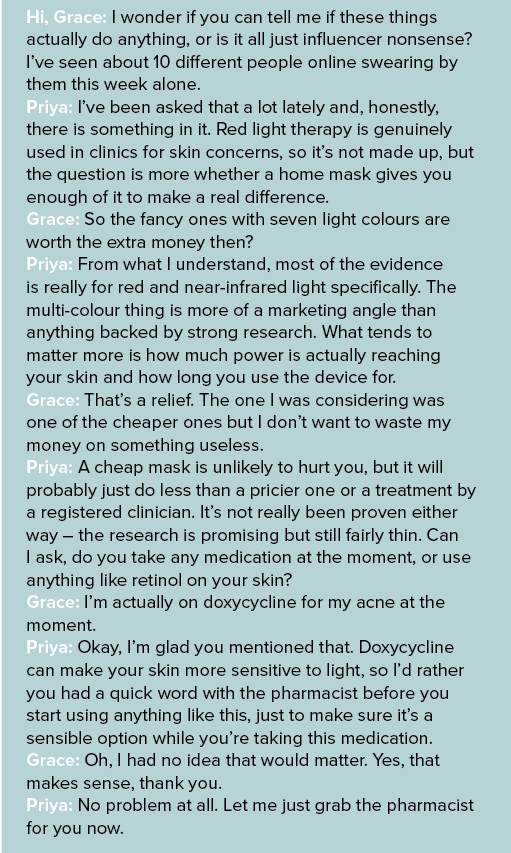
“Some work, but far more modestly than the smart marketing suggests,” says Dr Bratu. “Dose is what decides the product’s effectiveness, really. With LED, for instance, the benefit depends on the power actually reaching your skin multiplied by the time you spend under it.
That’s where cheap masks fail, as many are simply underpowered. And as there’s no standardised way of reporting output, two masks claiming identical wavelengths can deliver very different amounts of energy. A very cheap mask is usually not dangerous –just underwhelming.”
Dr Bratu also stresses that more expensive products are not automatically better. “Published output figures, a mask that fits the face without air gaps, and whether you’ll realistically keep using it all matter more than the price,” she says.
On a more positive note, microcurrent devices are a slightly different case. “Trials of home devices do show measurable improvements in tone and firmness,” says Dr Bratu.
“One randomised study ran five sessions a week for 12 weeks, but the effect fades once you stop, so microcurrent devices should be seen more like maintenance, not transformative.”
Pharmacy advice
Customers who are seriously considering buying their own LED and light treatment devices may have already done some research online, but what they’ve found could be a mixture of good information and persuasive marketing.
This is where a non-judgemental, informative approach works best for pharmacy teams wanting to explain what the evidence for these products actually says.
“My advice would be to start by agreeing with the part that’s true – if there’s something to agree with, of course,” advises Dr Bratu.
“Doing so disarms the whole conversation from the very beginning. Say something along the lines of ‘You’re right that light therapy is genuinely used in many clinics’, as a response like this is accurate and respectful, and it earns you permission to add the nuance.”
Then, Dr Bratu suggests, separate the three questions people tend to muddle:
- Does the technology work?
- Does this particular device deliver enough of it?
- Will it help my skin specifically?
“The honest answers are ‘often yes’, ‘probably not enough’, and ‘it depends’. I would avoid the word ‘proven’ too. The Cochrane review of light therapies for acne pooled 71 randomised trials, with a median of just 31 participants each, and still couldn’t draw firm conclusions.
Telling someone the research is promising but thin is more credible than delivering a verdict and, in my experience, clients and customers trust it far more than either enthusiasm or dismissal.”
Scenario
Dispensing assistant Priya is restocking the skincare shelf when a customer, Grace, comes in with a leaflet for an LED face mask.