


 Assessing risk
It is not acceptable to wait until accidents happen to put preventative measures in place. Risk assessments should be done to assess what possible negative consequences are likely to result from an event, how likely they are and what action (if any) should be taken to manage them.
Often, pharmacies will already have a plan for a risk assessment that has a very specific scope related to a concern, for example risks associated with the delivery process or with using a monitored dosage system.
Using risk assessment will help people prioritise which problems are the most critical to solve first and how best to solve them. Sometimes one solution can address several issues if they are recognised early on.
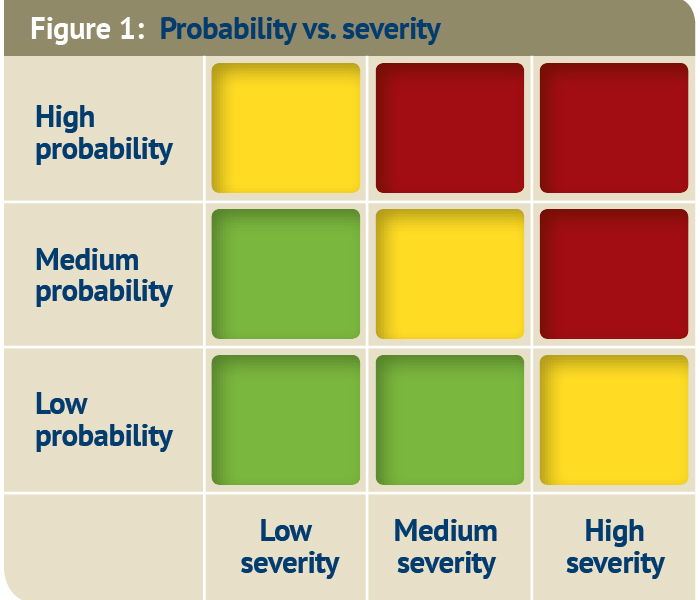
Many risk assessment methods use the concepts of ‘probability’ and ‘severity’ to try and identify which risks are most critical. These methods could involve an evaluation of low/medium/high or use a one to 10 scale, where one is usually the least probable/severe and 10 is the most probable/severe.
Other techniques also include a scale for ‘detectability’. A hidden risk that escalates without being noticed is likely to be more problematic, for example a fire developing in an area without a fi re alarm. In this case, the highest detectability (easiest to detect) is one and the lowest detectability is 10, reflecting the riskiness of the outcome. Usually, organisations will have a risk matrix that they use to map the results and decide whether they are high and are therefore the priority for immediate action, medium or low. There are several ways to do this, an example can be found in Figure 1.