It takes less than a minute to create your secure account – you just need to tell us
a few details about yourself and create a password.
I can’t remember my password
Please click on the “Forgot my password” link in the login form and follow the
instructions.
I can’t remember the email address I registered my account with
Please email info@pharmacy-network.co.uk so we can check for you.
What learning content do you have?
Training Matters contains a library of high-quality
educational e-learning modules, videos and articles to support your ongoing
learning.
Is the learning suitable for all pharmacy team members?
Yes, we have content suitable for all abilities, with topics covering business
management, clinical, practice and OTC. Our aim is to help you keep up to date and
develop your skills and knowledge to positively influence patient outcomes and customer
experiences.
Can I access the library on my mobile?
Yes, you can access all learning at work or at home on any mobile, PC or tablet
device
What’s the best way for me to find relevant content for my role?
There are three ways you can find relevant content. Firstly, the homepage will display
suggestions for you. If you are logged in, we can tailor the content to your particular
job role and topics of interest, as well as making it easy for you to see what’s
trending. Secondly, you can use the “search” function at the top of the website.
Finally, you can click on “explore” in the main menu and browse topics of interest to
you.
How long do modules take?
We have a range of modules and videos ranging from 2 minutes up to 15 minutes. There
is something for everyone, even if you are short on time.
Can I save content for later?
Yes. If you see a piece of learning you would like to take, but haven’t got time right
now, you can “Bookmark” it for later. Please note you need to have a registered account
and be logged in to access this feature.
Can I record my learning outcomes?
Yes, logged in members can record their learning outcomes on any piece of content and
save them in their learning log. Pharmacists and technicians can do this using recording
templates in line with GPhC requirements.
How do I get a learning log?
You have to register an account on Training Matters and login
to access your personal, secure learning log.
What does my learning log do?
It documents all the learning you have recorded, including completed learning, learning
in progress and bookmarked learning you have saved to do later.
If I’m a pharmacist or pharmacy technician, can the log help me fulfil the GPhC’s
revalidation requirements?
Yes, pharmacists and pharmacy technicians also have the ability to record and add their
own revalidation entries to their learning log in line with GPhC requirements.
If I’m a member of more than one website on The Training Matters,
can I access all my learning in my learning log even if I’ve recorded it on different
websites?
Yes, if you record learning on more than one website, it will be displayed in your
learning log which is shared across all the accounts you have registered with The
Training Matters.
How do I view/print a certificate of my learning?
Certificates are available at the end of every module, after the assessment questions.
They are also accessible via the learning log.
How do I change my personal details, email address and password?
Login and click on “Settings” in your member menu and click on the relevant links to
change any of your details. All saved changes take immediate effect.
If I leave the industry and want to delete my account, can I do so?
Yes absolutely. You are able to delete your account at any time but please be aware that
by doing so you will also delete any historical learning records you have in your
learning log.
If I have a query or I’m stuck, how can I get help?
You will need to have registered an account to get help. Logged in members can click on
the “Helpdesk” link in their Settings and submit a Helpdesk ticket. We endeavour to
respond to new Helpdesk tickets within 24 hours during office hours (9pm to 5pm Mon to
Fri)
How can I check on your Terms of Service, Privacy Policy and Cookie Policy?
You can click on the relevant links in the footer of the website. If there are any
proposed changes to any of our Policies, we will email registered members in
advance.
Is Training Matters GDPR compliant?
Yes we are and we take your privacy and the security of your data extremely
seriously. Please read the Privacy Policy for further details. Logged in members can
click on the “My data” link in “Settings” to download a copy of all the personal
data we currently hold on you.
Who is the company that owns and operates Training Matters?
Communications International Group Limited (CIG), the largest, most experienced publisher
in the UK pharmacy sector. CIG is one of the UK’s leading provider of sector-specific news and
training, publishing 15 healthcare and beauty titles including Pharmacy Magazine,
Training Matters, P3Pharmacy, Independent Community Pharmacist and Beauty Magazine. Over
the years the company has built an enviable reputation in pharmacy, journalism,
education, training, regulatory, awards and conferences, that today amounts to more than
350 years of healthcare industry experience.
How do I sign out?
Click on the Sign Out link that can be found at the top of the website, in you member
menu.
To learn more about Nuromol Pain Relief 200mg/500mg Film coated tablets, click on the headings below.
INDICATION
For the temporary relief of mild to moderate pain such as migraine, headache, backache, period pain, dental pain, rheumatic and muscular pain, cold and flu symptoms, sore throat and fever.
Nuromol Pain Relief should be used only after trying either ibuprofen or paracetamol individually.
DOSAGE
This medicine can be used in adults over 18 years old.
Each tablet contains ibuprofen 200 mg and paracetamol 500 mg.
Adults: One tablet to be taken up to three times a day. At least six hours should be left between doses.
If the one tablet dose does not control symptoms, a maximum of two tablets may be taken up to three times a day.
More than six tablets of Nuromol Pain Relief (3000mg Paracetamol, 1200mg Ibuprofen) should not be taken in any 24-hour period.
For oral use and for short term use only - not be used for longer than 3 days.
UNSUITABLE CUSTOMERS
Not for use by children or adolescents under 18 years.
Those who have medical conditions or take regular medicines or are pregnant or breastfeeding, should consult with their doctor or pharmacist before taking this medication.
The medicines should not be taken with any other paracetamol or NSAID containing products.
OTHER WAYS TO MANAGE PAIN15-17
Although physical pain can be caused by a multitude of conditions, and there are specific ways of managing them, there are ways in which people can help manage the intensity or frequency of pain without medication. Speeding up the recovery process and reducing the intensity of pain can also decrease the risk of addiction and dependence as customers may be less likely to seek further medicinal treatment.
Click through the carousel to understand different ways to reduce or relieve pain.
1. Gentle exercise
It is important to exercise care and not over-exert the body when injured, and to always ask for specific advice depending on the type of the injury. However, gentle exercise and stretching can help to ease pain by directly blocking pain signals to the brain.15,16 As well as working to strengthen muscles and joints, keeping active is beneficial to mental health.
2. Breathing and mindfulness
Concentrating on deep, slow breathing can help to ease pain, as it can help relieve anxiety and ease muscle tension.16
Relaxation techniques and practicing mindfulness, like meditation can also help to relieve pain.16
Resting and ensuring good sleep will aid the healing process and often sleep deprivation can worsen pain.16
Trying to shift attention onto something other than pain can help to distract the mind.16
3. Alternate therapies
Transcutaneous electrical nerve stimulations (TENS) machines help to reduce pain by blocking pain signals to the brain.17 Although evidence for long-term benefit is weak and it is important to know how to correctly use it, many find benefit from this method.
Manual therapy in the forms of physiotherapy and massages can help to reduce pain and improve the range of movement.17
Hot and cold therapy if often useful to manage muscle pain and tension. Cold therapy can also help to reduce inflammation.
References
1. Katz, N. The Impact of Pain Management on Quality of Life. J Pain Symptom Manage 2002;24:S38–S47.
3. RB internal report: RBHI/MI.290; Nuromol In-Vitro Dissolution summary report. Data on file
4. Tanner T, Aspley S, Thomas T, Munn A. The Pharmacokinetic Profile of a Novel Fixed-Dose Combination Tablet of Ibuprofen and Paracetamol. BMC Clinical Pharmacology 2010;10:10.
5. Yue Y, Collaku A, Brown J, Buchanan WL, Reed K, Cooper SA, Otto J. Efficacy and Speed of Onset of Pain Relief of Fast-Dissolving Paracetamol on Postsurgical Dental Pain: Two Randomized, Single-Dose, Double-Blind, Placebo-Controlled Clinical Studies. Clinical Therapeutics 2013;35(9).
6. Rostami-Hodjegan A, et al. A New Rapidly Absorbed Paracetamol Tablet Containing Sodium Bicarbonate. I. A Four-Way Crossover Study to Compare the Concentration-Time Profile of Paracetamol from the New Paracetamol / Sodium Bicarbonate Tablet and a Conventional Paracetamol Tablet in Fed and Fasted Volunteers. Drug Development and Industrial Pharmacy 2002;28(5):523-31.
7. Atkinson HC, et al. A Pharmacokinetic Analysis of a Novel Fixed Dose Oral Combination of Paracetamol and Ibuprofen, with Emphasis on Food Effect. Journal of Bioequivalence & Bioavailability 2015;7:3.
8. Tarabar S, et al. Phase I Pharmacokinetic Study of Fixed-Dose Combinations of Ibuprofen and Acetaminophen in Healthy Adult and Adolescent Populations. Drugs in R&D 2020;20:23–37.
9. Wright CE, Antal EJ, Gillespie WR, Albert KS. Ibuprofen and Acetaminophen Kinetics When Taken Concurrently. Clinical Pharmacology and Therapeutics 1983;34(5):707-710.
12. Kinnaird E, et al. From pain treatment to opioid dependence: a qualitative study of the environmental influence on codeine use in UK adults. BMJ Open 2019;9:e025331
13. Daniels S et al. A randomised, five-parallel-group, placebo-controlled trial comparing the efficacy and tolerability of analgesic combinations including a novel single-tablet combination of ibuprofen/paracetamol for postoperative dental pain. Pain. 2011 PMID: 21257263
Nuromol Pain Relief 200mg/500mg Film Coated Tablets
Active Ingredient (s): Each tablet contains ibuprofen 200 mg and paracetamol 500 mg. Indications: For the
temporary relief of mild to moderate painassociated with migraine, headache, backache, period pain, dental
pain, rheumaticand muscular pain, pain of non-serious arthritis, cold and flu symptoms, sore throatand fever.
This product is especially suitable for pain which has not been relieved by ibuprofen or paracetamol alone.
Nuromol Pain Relief 200mg/500mg Film Coated Tablets is indicated in adults aged 18 years. Dosage &
Administration: For oral administration and short term-use only (not more than 3 days). The lowest effective
dose should be used for the shortest duration necessary to relieve symptoms (seesection 4.4). The patient
should consult a doctor if the symptoms persist or worsen or if the product is required for more than 3 days.
This medicine is for short-term use and it is not recommended for use beyond 3 days. Adults: One tablet to be
taken up to three times per day with water. The interval between single doses should be at least six hours. If the
one tablet dose does not control symptoms, a maximum of two tablets may be taken up to three times a day.
Leave at least six hours between doses. Do not take more than six tablets (1200mg Ibuprofen, 3000mg
Paracetamol) in any 24 hours period. To minimise side effects, it is recommended that patients take this
medicine with food. Elderly: No special dosage modifications are required (see section 4.4). The elderly are at
increased risk of the serious consequences of adverse reactions. If an NSAID is considered necessary, the
lowest effective dose should be used for the shortest possible duration. The patient should be monitored
regularly for gastrointestinal bleeding during NSAID therapy. Paediatric population: Not for use by children and
adolescents under 18 years. Method of administration: Oral use. Contraindications: This product is
contraindicated: • In patients with a known hypersensitivity to active substances - ibuprofen, paracetamol or to
any of the excipients listed in section 6.1. • In patients with a history of hypersensitivity reactions (e.g.
bronchospasm, angioedema, asthma, rhinitis, or urticaria) associated with acetylsalicylic acid or other nonsteroidal
anti-inflammatory drugs (NSAIDs). • In patients with a history of, or an existing gastrointestinal
ulceration/perforation or bleeding, including that associated with NSAIDs (see Section 4.4). • Patients with
defects in coagulation. • In patients with severe hepatic failure, severe renal failure or severe heart failure (NYHA
Class IV) (see Section 4.4). • In concomitant use with other NSAID containing products, including cyclooxygenase-
2 (COX-2) specific inhibitors and doses of acetylsalicylic acid above 75 mg daily – increased risk of
adverse reactions (see Section 4.5). • In concomitant use with other paracetamolcontaining products –
increased risk of serious adverse effects (see Section 4.5). • During the last trimester of pregnancy due to risk
of premature closure of the foetal ductus arteriosus with possible pulmonary hypertension (see Section 4.6)
Special warnings and precautions for use: This medicine is for short-term use and is not recommended for use
beyond 3 days. Paracetamol: Care is advised in the administration of Paracetamol to patients with severe renal
or severe hepatic impairment. The hazard of paracetamol overdose is greater in patients with noncirrhotic
alcoholic liver disease. Do not take with any other paracetamol-containing products. Immediate medical advice
should be sought in the event of an overdose, even if the patient feels well, because of the risk of delayed,
serious liver damage (see section 4.9). Caution is advised if paracetamol is administered concomitantly with
flucloxacillin due to increased risk of high anion gap metabolic acidosis (HAGMA), particularly in patients with
severe renal impairment, sepsis, malnutrition and other sources of glutathione deficiency (e.g. chronic
alcoholism), as well as those using maximum daily doses of paracetamol. Close monitoring, including
measurement of urinary 5-oxoproline, is recommended. Ibuprofen: Undesirable effects may be minimised by
using the lowest effective dose for the shortest duration necessary to control symptoms (see Section 4.2, and
gastrointestinal and cardiovascular risks below) and by patients taking the dose with food (see Section 4.2).
Elderly: The elderly have an increased frequency of adverse reactions to NSAIDs especially gastrointestinal
bleeding and perforation which may be fatal (see Section 4.2). Caution is required in patients with certain
conditions: • Respiratory disorders: In patients suffering from, or with a history of, bronchial asthma or allergic
disease NSAIDs have been reported to precipitate bronchospasm. • Cardiovascular, renal and hepatic
impairment: The administration of NSAIDs may cause a dose dependent reduction in prostaglandin formation
and precipitate renal failure. Patients at greatest risk of this reaction are those with impaired renal function,
cardiac impairment, liver dysfunction, those taking diuretics and the elderly. Renal function should be monitored
in these patients. Treatment should be stopped in those patients who develop severe renal failure (see Section
4.3). Dose reduction is recommended in patients showing signs of worsening hepatic function. Treatment
should be stopped in those patients who develop severe liver failure (see section 4.3). • Cardiovascular and
cerebrovascular effects: Appropriate monitoring and advice are required for patients with a history of
hypertension and/or mild to moderate congestive heart failure as fluid retention and oedema have been
reported in association with NSAID therapy. Clinical studies suggest that use of ibuprofen, particularly at high
doses (2400 mg daily) with a small increased risk of arterial thrombotic events (e.g. myocardial infarction or
stroke). Overall, epidemiological studies do not suggest that low dose ibuprofen (e.g. ≤1200mg daily) is
associated with an increased risk of arterial thrombotic events. Patients with uncontrolled hypertension,
congestive heart failure (NYHA II-III), established ischaemic heart disease, peripheral arterial disease, and/or
cerebrovascular disease should only be treated with ibuprofen after careful consideration and high doses (2400
mg/day) should be avoided. Careful consideration should be exercised before initiating longterm treatment for
patients with risk factors for cardiovascular events (e.g. hypertension, hyperlipidaemia, diabetes mellitus,
smoking) particularly if high doses of ibuprofen (2400 mg/day) are required. • Gastrointestinal bleeding,
ulceration and perforation: Gastrointestinal (GI) bleeding, ulceration and perforation, which can be fatal, has
been reported with all NSAIDs at any time during treatment, with or without warning symptoms or a previous
history of serious GI events. The risk of GI bleeding, ulceration or perforation is higher with increasing NSAID
doses, in patients with a history of ulcer, particularly if complicated with haemorrhage or perforation (see
Section 4.3) and in the elderly. These patients should commence treatment on the lowest dose available.
Combination therapy with protective agents (e.g. misoprostol or proton pump inhibitors) should be considered
for these patients, and also for patients requiring concomitant low dose acetylsalicylic acid, or other drugs likely
to increase gastrointestinal risk (see below and 4.5). Patients with a history of GI toxicity, particularly the elderly,
should report any unusual abdominal symptoms (especially GI bleeding) particularly in the initial stages of
treatment. Caution should be advised in patients receiving concomitant medications which could increase the
risk of ulceration or bleeding, such as oral corticosteroids, anticoagulants such as warfarin selective serotoninreuptake
inhibitors or antiplatelet agents such as acetylsalicylic acid (see Section 4.5). When GI bleeding or
ulceration occurs in patients receiving ibuprofen containing products, the treatment should be withdrawn.
NSAIDs should be given with care to patients with a history of GI disease (ulcerative colitis, Crohn’s disease) as
these conditions may be exacerbated (see Section 4.8). • SLE and mixed connective tissue disease: In patient
with systemic lupus erythematosus (SLE) and mixed connective tissue disease disorders there may be an
increased risk of aseptic meningitis (see Section 4.8). • Severe skin reactions: Serious skin reactions, some of
them fatal, including exfoliative dermatitis, Stevens-Johnson syndrome, and toxic epidermal necrolysis, have
been reported very rarely in association with the use of NSAIDs (see Section 4.8). Patients appear to be at
highest risk of these reactions early in the course of therapy, the onset of the reaction occurring in the majority
of cases within the first month of treatment. Acute generalised exanthematous pustulosis (AGEP) has been
reported in relation to ibuprofen-containing products. Use of this product should be discontinued at the first
appearance of signs and symptoms of severe skin reactions, such as skin rash, mucosal lesions, or any other
sign of hypersensitivity. • Impaired female fertility: The use of the product may impair female fertility and is not
recommended in women attempting to conceive. In women who have difficulties conceiving or who are
undergoing investigation of infertility, withdrawal of the product should be considered. Masking of symptoms of
underlying infections This medicinal product can mask symptoms of infection, which may lead to delayed
initiation of appropriate treatment and thereby worsening the outcome of the infection. This has been observed
in bacterial community acquired pneumonia and bacterial complications to varicella. When this medicine is
administered for fever or pain relief in relation to infection, monitoring of infection is advised. In non- hospital
settings, the patient should consult a doctor if symptoms persist or worsen.
System Organ Class
Frequency
Adverse Events
Blood and lymphatic system disorders
Very rare (≤1/10,000)
Haematopoietic disorder.
Immune system disorders
Uncommon
Hypersensitivity with urticaria and pruritus.
Very rare (≤1/10,000)
Severe hypersensitivity reactions. Symptoms can include facial, tongue and throat swelling, dyspnoea, tachycardia, hypotension (anaphylaxis, angioedema or severe shock).
Psychiatric disorders
Very rare (≤1/10,000)
Confusion, depression and hallucinations.
Nervous system disorders
Uncommon (≥1/1,000 to ≤1/100)
Headache and dizziness.
Rare
Paraesthesia.
Very rare (≤1/10,000)
Aseptic meningitis, optic neuritis and somnolence.
Eye disorders
Very rare (≤1/10,000)
Visual disturbance
Ear and labyrinth disorders
Very rare (≤1/10,000)
Tinnitus and vertigo.
Cardiac disorders
Common
Oedema.
Very rare (≤1/10,000)
Cardiac failure.
Vascular disorders
Very rare
Hypertension.
Respiratory, thoracic and mediastinal disorders
Very rare (≤1/10,000)
Respiratory tract reactivity including: asthma, exacerbation of asthma, bronchospasm and dyspnoea.
Gastrointestinal disorders
Common
Abdominal pain, vomiting, diarrhoea, dyspepsia, nausea and abdominal discomfort.
Very rare (≤1/10,000)
Same as above (likely duplicate).
Uncommon (≥1/1,000 to ≤1/100)
Peptic ulcer, gastrointestinal perforation or gastrointestinal haemorrhage, melaena, haematemesis, mouth ulceration, exacerbation of ulcerative colitis and Crohn’s disease, gastritis, pancreatitis, flatulence and constipation.
Hepatobiliary disorders
Very rare (≤1/10,000)
Abnormal liver function, hepatitis and jaundice.
Skin and subcutaneous tissue disorders
Common
Hyperhidrosis.
Uncommon
Various skin rashes.
Very rare
Bullous reactions including Stevens-Johnson syndrome, erythema multiforme and toxic epidermal necrolysis. Exfoliative dermatoses, purpura, photosensitivity.
Renal and urinary disorders
Very rare (≤1/10,000)
Nephrotoxicity in various forms, including interstitial nephritis, nephrotic syndrome, and acute and chronic renal failure.
General disorders and administration site conditions
Very rare (≤1/10,000)
Fatigue and malaise.
Investigations
Common (≥1/100 to ≤1/10)
Alanine aminotransferase increased, gamma-glutamyltransferase increased and liver function tests abnormal with paracetamol. Blood creatinine increased and blood urea increased.
Legal Classification: P Licence Holder: Reckitt Benckiser Healthcare (UK) Limited, Slough, SL1 3UH Licence Number: PL 00063/0579 Price (ex VAT): £6.99 Last Revised: 10/06/2022
Adverse events should be reported. Reporting forms and information can be found at
www.mhra.gov.uk/yellowcard or search for the MHRA Yellow Card in the Google Play or
Apple App Store. Adverse events should also be reported to Reckitt Benckiser Healthcare
(UK) Ltd on: 0333 200 5345


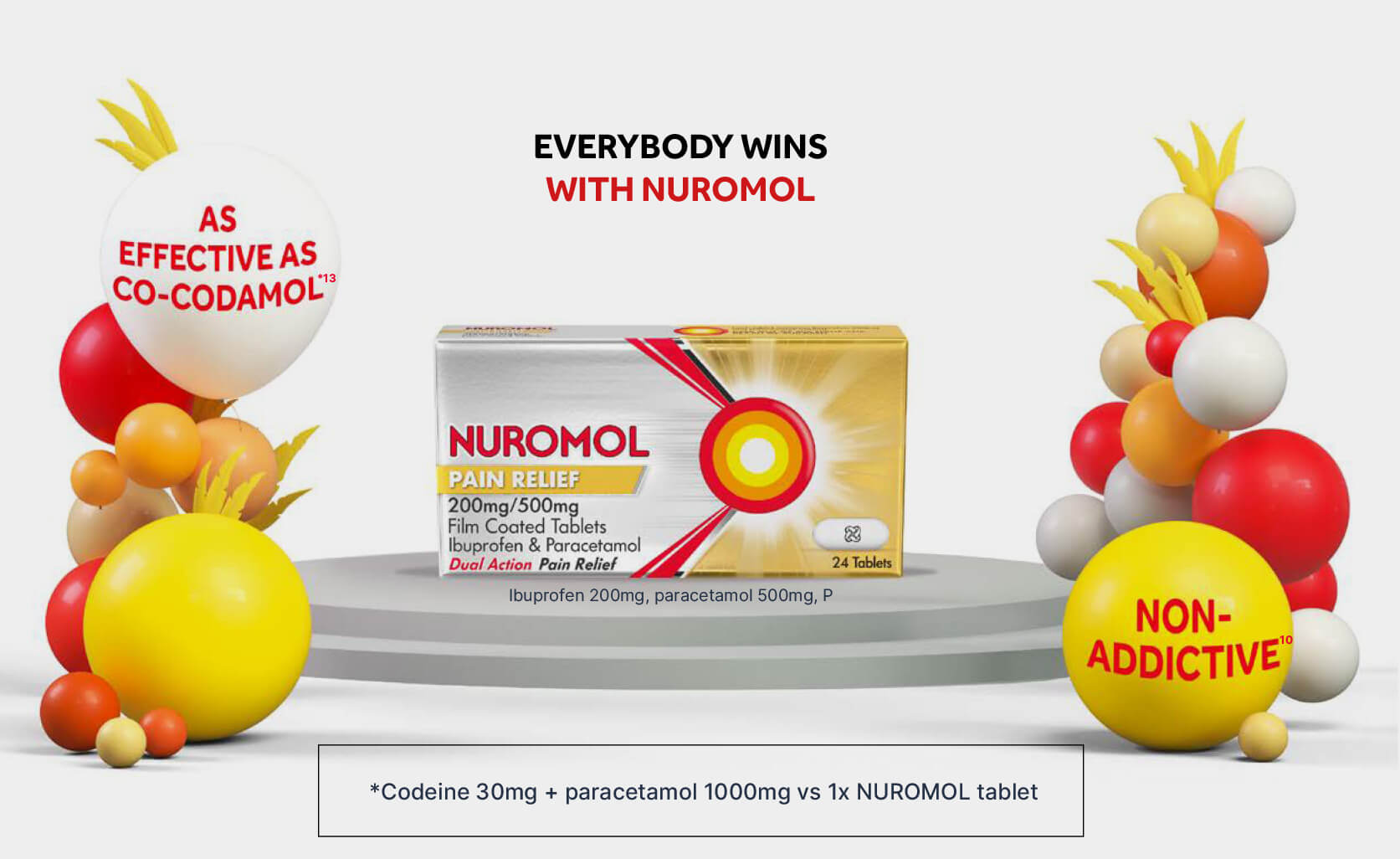
 Everybody wins with Nuromol