Cultural competence and sensitivity
Cultural competence and sensitivity
The term ‘culture’ has been interpreted in various ways, but broadly refers to shared patterns of thinking, feeling, believing, reacting and problem-solving.
Cultural competence means that healthcare professionals can understand, communicate and interact effectively with people from different cultural backgrounds.
Food choices are influenced by many factors, including household dynamics, community influences and socio-cultural norms.
As a result, culturally appropriate weight management advice is more likely to benefit patients from different ethnic backgrounds than standardised, traditional approaches.
In terms of weight management advice, cultural competence enables pharmacy teams to:
- Provide tailored care that aligns with the patient’s values, beliefs and personal needs
- Reduce the potential for health inequalities
- Improve patient health outcomes and satisfaction.
The most important aspects of weight management advice are personalisation and respect: treating patients as individuals while acknowledging ethnic-specific risks and cultural contexts.
Food is an important part of identity, and traditional foods are often highly valued. Qualitative research involving South Asian patients has shown that family and community pressures to conform to social norms can strongly influence the consumption of traditional foods.
Translating dietary advice to align with traditional cultural foods can be challenging, and recommendations should be framed within the context of those foods rather than advocating a Westernised diet.
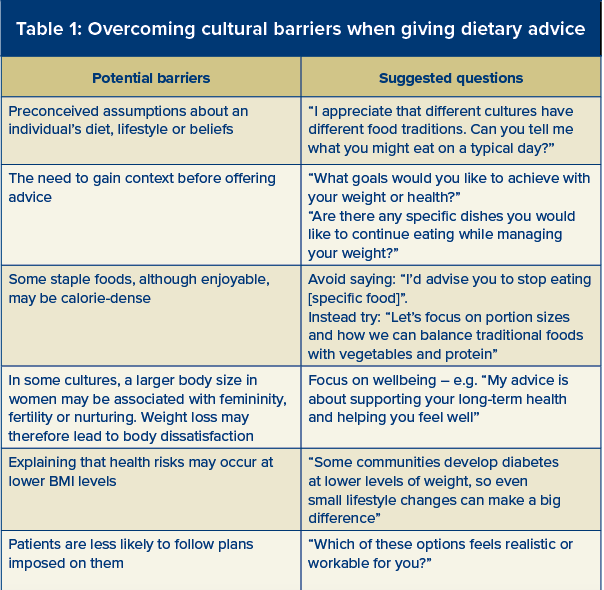
In addition, offering weight management advice to patients from diverse cultures requires recognition of several potential barriers that must be addressed.
Pharmacy technicians should adopt a culturally competent, person-centred approach, rather than viewing someone simply as, say, African or South Asian.
Ways of overcoming these barriers, with suggested questions to use in a consultation, are outlined in Table 1, below.