


 Starting the conversation
Most members of the public are confused by how much and what sort of physical activity they should be aiming for. Work commitments and lack of leisure time are reported as the most common barriers to doing more physical activity. The key questions are:
- How much is good for you?
- How often?
- What intensity?
- How long should each session of physical activity last?
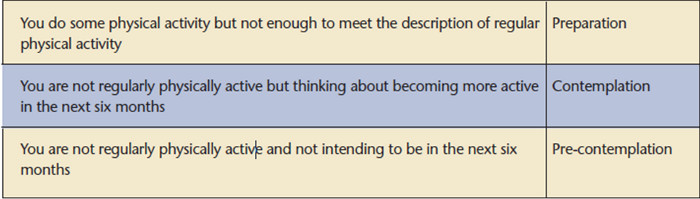
The ‘Let’s Get Moving’ primary care screening questions can be useful. People are asked which statement in Figure 1 most applies to them. These simple statements provide you and the customer with a helpful starting point for a discussion. For people who are in the preparation or contemplation stage, try to find out more about their lifestyle and make suggestions that will fit with their daily habits and preferences. When someone is in the precontemplation stage, encourage further discussion in the future. Make a note on their PMR to remind you of the conversation and record a suggested date to bring up the subject again. The NHS recommendations for adults aged 19-64 and those aged 65 and over who are generally fit and have no health conditions that limit their mobility are the same(see box below).
NHS recommendations for adults aged 19 and over
- At least 150 minutes (two hours and 30 minutes) of moderateintensity aerobic activity, such as cycling or fast walking every week, and muscle-strengthening activities on two or more days a week that work all major muscle groups (legs, hips, back, abdomen, chest, shoulders and arms)
OR
- 75 minutes (one hour and 15 minutes) of vigorous-intensity aerobic activity, such as running every week, and musclestrengthening activities on two or more days a week that work all major muscle groups (legs, hips, back, abdomen, chest, shoulders and arms)
OR
- An equivalent mix of moderate and vigorous-intensity aerobic activity every week (e.g. two 30-minute runs plus 30 minutes of fast walking), and muscle-strengthening activities on two or more days a week that work all major muscle groups (legs, hips, back, abdomen, chest, shoulders and arms).
Figure 1: Defining physical activity intentions in sedentary people
No one is too old to benefit from regular physical activity and most people can start a gentle programme without any problems. Exercise sessions should be postponed during illnesses such as colds and flu, and care should be taken when the weather is very hot or humid. Moderate activity slightly raises the heart rate. Examples of moderate intensity, daily living physical activity (around 150 calories per activity), include:
Less vigorous, more time
- Cleaning windows or floors for 45-60 minutes
- Decorating (painting, wallpapering) for 45-60 minutes
- Gardening for 45-60 minutes
- Walking a mile and three quarters in 35 minutes (20 minutes per mile) – walking up a five per cent gradient increases energy expenditure by 50 per cent
- Cycling five miles in 30 minutes (10 miles per hour)
- Pushing a pushchair one and a half miles in 30 minutes (20 minutes per mile).
More vigorous, less time
- Walking two miles in 30 minutes (15 minutes per mile)
- Aqua aerobics for 30 minutes
- Cycling four miles in 15 minutes (16 miles per hour)
- Skipping for 15 minutes
- Running one and a half miles in 15 minutes (10 minutes per mile)
- Stair walking for 15 minutes.
Some activities can be performed at different intensities. The aim should be for a feeling of mild fatigue, not exhaustion. Older people who walk as their main form of activity should take the ‘talk test’ and should slow down if they cannot carry on a conversation while walking.
Muscle-strengthening activities include:
- Lifting weights
- Working with resistance bands
- Exercises that use body weight for resistance, such as push-ups and sit-ups
- Heavy gardening
- Yoga.