



 4 Min
4 Min In In-depth

Follow this topic

Bookmark

Record learning outcomes
For many who have worked in community pharmacy for a long time, they may feel as if they are repeating themselves year after year delivering stop smoking advice. Every day, pharmacy teams administer tobacco harm reduction guidance, and yet every day, people continue to smoke.
Like many other habits humans have formed over time, smoking is one that people know is bad for them – harmful in fact – and yet they do it anyway. But if pharmacy teams can help even one person every so often to quit smoking, they will have significantly changed that customer’s health for the better.
With so much advice to give and stop smoking treatment options to recommend, how can pharmacy teams carry out the first crucial step in the smoking cessation journey – the striking up of that initial conversation that inspires a customer to reconsider their habit? We spoke to experts from Asthma + Lung UK as well as Action on Smoking and Health (ASH) to find the answer.
“Community pharmacy teams are trusted and accessible healthcare professionals, and they have an important role to play in supporting healthier communities,” says Rachel Maynard, senior policy officer at ASH. “Everyday conversations with the public provide opportunities to raise the health risks of smoking.”
Bad for the body
Smoking’s most notable negative health consequence is that it can cause lung cancer. However, it is linked to a plethora of other negative physical health outcomes, can damage mental health, and carries financial implications, too. “Smoking remains the largest preventable cause of illness and premature death. It damages almost every organ in the body and increases the risk of a wide range of conditions,” says Rachel. “It is the leading cause of preventable cancers, causing around one in four of all UK cancer deaths, and significantly increases the risk of cardiovascular disease.
“It also increases the risk of respiratory disease, including COPD and other long-term lung conditions. Quitting smoking is the single most important thing that people who smoke can do to improve their health.”
For pharmacy teams interacting with customers who are not aware of the negative health implications of smoking, you can share this list (which is not exhaustive) with them. According to the NHS, smoking can:
- Increase the risk of hearing loss and eye problems like cataracts, glaucoma, dry eyes and age-related vision damage
- Increase the risk of dementia because it damages blood vessels, and this is linked to vascular dementia and Alzheimer’s disease
- Increase inflammation in the body, leading to joint pain and damage. It can also increase the risk of conditions like rheumatoid arthritis, back pain and osteoporosis
- Cause heartburn, ulcers, liver problems, and lead to a higher risk of Crohn’s disease, pancreatitis and gallstones
- Damage blood pressure, narrow arteries and put extra strain on the heart by raising blood pressure.
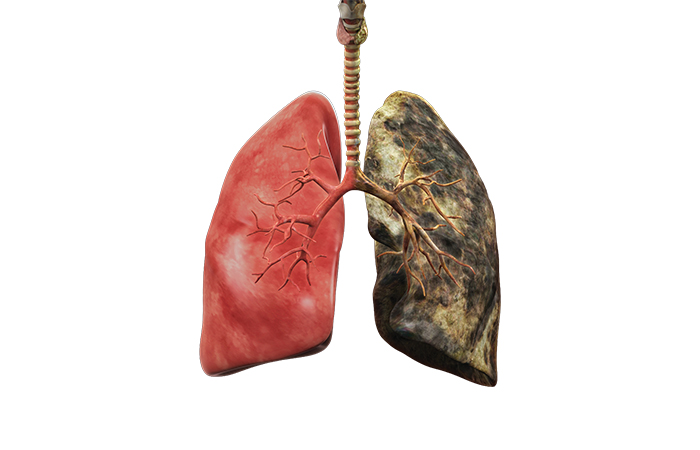
A healthy lung versus a smoker’s lung.
Bad for the mind
If the standout link between smoking and physical health is lung cancer, then the equivalent for mental health and smoking is that it is a stress reliever – the only problem here is that this is a widely accepted myth. “While smoking may feel like it helps with stress or anxiety in the moment, much of this relief is from relieving nicotine withdrawal rather than treating the underlying symptoms,” says Rachel. “Smoking and mental health have a bidirectional relationship. People experiencing mental health conditions are significantly more likely to smoke, but there is also growing evidence that smoking itself can increase the risk of developing mental health conditions, including depression and schizophrenia.”
Once the feeling of relaxation associated with smoking wears off, it can leave a person feeling even more anxious, stressed and down. “This can lead to smoking more often,” says the NHS. “Instead of fixing the problem, it can create a cycle where anxiety and depression get worse,
not better.”
Quitting smoking means that the chemicals in the brain that work naturally to lift mood start to balance out. Over time, this means a person feels happier, less anxious and more in control of their moods.
“Nicotine dependence contributes to a cycle of cravings, withdrawal and short-term relief,” says Rachel. “Quitting smoking can improve mental health and is associated with improvements in mood, anxiety, stress and overall wellbeing. For people with depression or anxiety, these improvements can be comparable to those seen with antidepressant treatment.
“For community pharmacy teams, this means smoking should be seen as an important part of supporting both mental and physical health, rather than something that needs to wait until someone’s mental health has improved.”
“Quitting smoking is the single most important thing that people can do to improve their health”
Bad for the wallet
Not to be forgotten is the financial cost of smoking. Pharmacy teams can, when discussing smoking cessation with customers, lay out just how much they may be spending on cigarettes as an extra bit of motivation.
In the UK, the average price of a standard pack of 20 cigarettes ranges between £14 and £16.50, but more premium brands can cost £18 to £20. This means that if someone is spending the lowest possible amount of £14 and smokes half a pack a day, they would be spending an estimate of:
- £213 a month
- £1,277 after six months
- £2,555 a year
- £12,775 for five years
- £25,550 over 10 years.
Pharmacy teams can encourage customers who are on the journey to quit smoking to put the money they would have spent on cigarettes into a jar or separate bank account each time they would usually go to buy a pack, and see how much they can save. What could they put that extra money towards?

How to help
After making customers aware of the impacts of smoking, pharmacy teams can let them know about smoking cessation services that may be available in the pharmacy, as well as OTC treatments that can relieve cravings as they begin their journey. Customers who might benefit from a prescription only stop smoking medication can be referred to the pharmacist. Quitting smoking ‘cold turkey’ is an option, but it does not work for everyone.
“You are three times more likely to quit smoking successfully if you have support,” says Nazir Hussain, respiratory pharmacist and clinical lead at Asthma + Lung UK.
Nicotine withdrawal symptoms are likely to be the first issue that customers quitting smoking will encounter. “Nicotine withdrawal is one of the biggest challenges during a quit attempt. Pharmacy teams can help those trying to quit understand that cravings, irritability, difficulty concentrating and restlessness are common symptoms, and that there are effective ways to manage them,” says Rachel. “Pharmacy teams can support people to use evidence-based treatments such as nicotine replacement therapy (NRT) and stop smoking medicines, helping them choose the most appropriate option.”
NRT is available as gum, patches, lozenges, microtabs, inhalators and sprays for the mouth and nose. “For adults who smoke, vaping can also be used as an effective tool to manage nicotine cravings and support a quit attempt,” says Rachel. “Pharmacy teams can also help ensure people have accurate information about vaping. For adults who smoke, evidence shows that vaping is substantially less harmful than smoking and is one of the most effective quitting aids.”
Nazir believes that vaping should be seen as a smoking cessation tool, and not simply a replacement for smoking. “While vaping is less harmful than smoking, people who vape will also need support with their nicotine addiction so they can end their use of vapes completely,” he says.
Some customers may be sceptical about vaping, so explaining the reasoning behind them as a smoking cessation tool rather than a sweet-tasting substitute for cigarettes is important.
Vaping is, of course, not completely risk-free. “More research is needed into the long-term effects of vaping, but it can cause inflammation in the airways, and people with lung conditions like asthma and chronic obstructive pulmonary disease (COPD) have told us that vapes can trigger their lung condition,” cautions Nazir.
Playing your part
There is plenty of self-care advice that pharmacy teams can pass on to customers alongside smoking cessation medication. This includes:
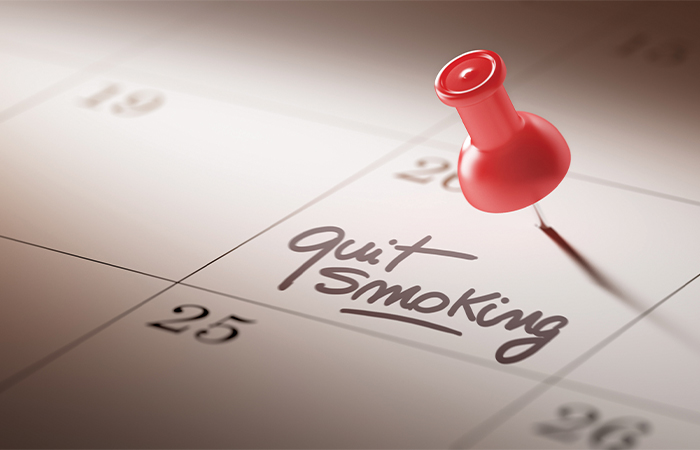
- Set a quit date and stick to it
- Make a plan that includes how to handle situations where there may be a temptation to smoke
- List reasons for quitting and keep them handy to refer to when needed
- Identify when cravings are likely to occur and have some strategies in place to cope with them
- Get rid of all smoking reminders, like ashtrays and lighters
- Plan what to do with the time and money freed up by stopping smoking
- Tell family and friends about the quit attempt to garner support and understanding.
“Everyone in the pharmacy team can help people quit smoking. This could mean asking if someone smokes, having a quick conversation, signposting them to stop-smoking support, or encouraging them if they are struggling,” says Nazir. “It’s important to know what support is available locally and when to refer someone for further help.”
Rachel notes that it is also important to recognize when a customer may need help beyond what the pharmacy can provide. “Where someone needs more intensive or ongoing support, pharmacy teams can refer them to their local stop smoking service,” she says. “These services can provide behavioural support alongside treatment, which can give people the best possible chance of successfully stopping smoking.”
Providing support to customers you know are on a stop smoking journey can make all the difference.
Remind people that they are stronger than their habit, and of the numerous benefits that come with quitting smoking – including creating a smoke-free environment for their loved ones, who would otherwise be involuntarily impacted by second-hand smoke. Each cigarette refused is a step towards a physically and mentally healthier future for the smoker and their friends and family.
If a customer feels that they are not coping despite making use of an NRT treatment option, you can encourage them to try a different type of NRT, or a combination of types. For some people, there will be a trial and error period before they find what works, or they may need to be referred to the pharmacist or their GP to explore alternative treatment options. What matters most is that all customers are encouraged not to give up.
“Everyone in the pharmacy team can help people quit smoking”
Breaking down
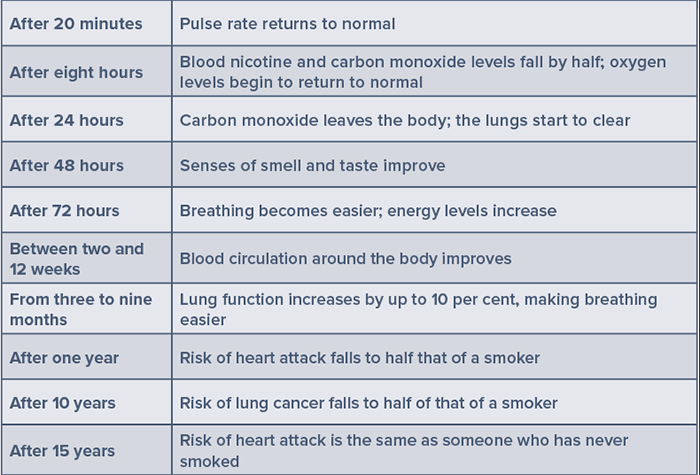
A common misconception when it comes to giving up smoking, and perhaps a common excuse too, is that for a smoker, “the damage is done” and there is no point quitting so far down the line. Pharmacy teams can set the record straight in letting customers know that quitting smoking is always a good idea, and has almost immediate health benefits, no matter how many days, months or years a person has been smoking. “Quitting smoking will save you money and your health will start to improve straight away,” says respiratory pharmacist and clinical lead at Asthma + Lung UK, Nazir Hussain. The table below demonstrates the timeline of effects after someone puts out their cigarettes.

Share:


In In-depth