This site is intended for Healthcare Professionals only

3. Practical advice

3. Practical advice

Moving on from milk to adding solid food to a baby's diet can be daunting for both the baby and the parents. But some simple tips can make the process run as smoothly as possible

Do's and don'ts

Most ingredients are safe for babies, but advise parents:  

  • Not to add salt to food as it is bad for babies’ kidneys. Avoid stock cubes and gravy too as these are often high in salt
  • Not to add sugar to babies’ food. However, natural sugars from mashed fruit or breast
    and/or formula milk are fine
  • To avoid honey until the age of 12 months. Occasionally, honey contains bacteria that can produce toxins in a baby’s intestines, leading to infant botulism, which is a very serious illness. As honey is also a sugar, so avoiding it helps prevent tooth decay 
  • To avoid wheat, gluten, peanuts, nuts, soya, meat, fish, dairy and other potential allergens until six months of age as they may cause allergies or make the baby ill. When these are introduced, they should be done so one at a time so any reaction can be easily spotted
  • Not to give whole peanuts or nuts to children under five years old due to the risk of choking
  • Not to choose low fat foods. Fat is an important source of calories and certain vitamins for babies and young children. It is better for infants between the ages of six months and two years to have full-fat dairy products
  • Not to give shark, swordfish or marlin. The amount of mercury in these fish can affect a baby’s growing nervous system
  • Always check the labels of cooking sauces, soups, breakfast cereals, etc., as they may contain high levels of salt, sugar or artificial sweeteners.

Do not add salt to food as it is bad for babies’ kidneys. Avoid stock cubes and gravy too as these are often high in salt

  Top tips for starting weaning

Parents can try the following: 

•  Choose a time of day when they are relaxed and the baby is alert

•  Try giving the baby food during or after a milk feed so they are not hungry and do not get frustrated when expecting the breast or a bottle

•  To begin with, offer a couple of teaspoonfuls of food once a day

•  Allow plenty of time and prepare to get messy

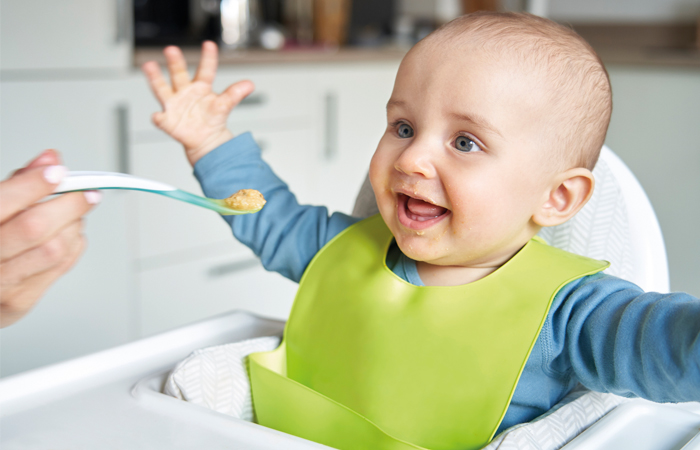
•  Wait for the baby to open their mouth before spoon-feeding 

•  If the baby doesn’t seem to like a particular food, don’t force it – just try again another day

•  Let the baby learn and get used to individual tastes before mixing foods, particularly fruit and vegetables 

•  Remember to keep introducing the baby to a wide range of healthy tastes and textures by trying new foods – this way they are more likely to keep eating them as they grow up. It can take 10 or more attempts before a baby accepts a new food, so keep trying

•  Gradually increase the amount of food and offer food twice and then three times a day. The aim will eventually be to get babies eating three meals a day – breakfast, lunch and dinner – with healthy snacks in between

•  Be positive and praise the baby for trying new foods.

Share:

Change privacy settings